About the Department
What is Pathology?
Pathology is the branch of medicine that studies the causes of diseases, their development mechanisms, and the structural changes they create in the body. Understanding diseases requires evaluating changes in cells, tissues, and organs, which provides essential information for accurate diagnosis and classification.
In many cases, diseases cannot be definitively diagnosed through clinical examination alone. Although imaging methods and laboratory tests provide valuable insights, cellular-level analysis is often necessary. This is where pathology plays a crucial role, revealing the fundamental characteristics of diseases.
Importance of Pathology in Diagnosis
In modern medicine, many diseases require microscopic examination for a definitive diagnosis. Evaluating tissue samples obtained from suspicious areas helps determine the exact nature of a disease.
For example, structural changes in tissues or abnormal cell growth can be identified under a microscope, providing critical insights. Therefore, pathology serves as a complementary and essential component of the diagnostic process.
How is a Pathological Examination Performed?
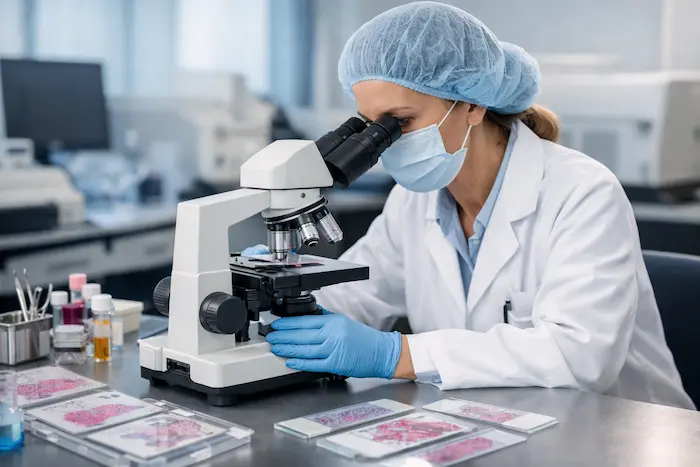
Pathological evaluation is typically performed on tissue samples obtained through biopsy or surgery. These samples are processed in laboratory settings and prepared for microscopic examination.
During this process, cells are analyzed in terms of:
- Shape
- Size
- Nuclear structure
- Tissue organization
Abnormal findings compared to normal tissue structures help identify and understand diseases. These evaluations are conducted by specialist pathologists.
Fields That Work with Pathology
Pathology collaborates with many clinical branches, including:
- General Surgery
- Dermatology
- Obstetrics and Gynecology
- Gastroenterology
- Oncology
Tissue samples obtained from these departments are evaluated in pathology, making it a central discipline supporting diagnosis across medicine.
Modern Approaches in Pathology
Today, pathology is not limited to traditional microscopic examination. With technological advancements, molecular and advanced diagnostic methods are also used.
Molecular analysis allows for a deeper understanding of the genetic and biological characteristics of diseases, especially in cancer. These developments contribute to more accurate diagnoses and more effective treatment planning.
What Diseases Does Pathology Deal With?
Pathology plays a key role in diagnosing a wide range of diseases, including:
- Cancer
- Infectious diseases
- Autoimmune disorders
- Metabolic diseases
By analyzing tissues at the cellular level, pathology helps uncover the underlying causes and progression of diseases.
Role of Pathology in Cancer Diagnosis
Pathology is fundamental in diagnosing cancer. While imaging methods may detect tumors, tissue examination is required to determine whether a tumor is benign or malignant.
Pathologists evaluate:
- Cellular structure
- Growth patterns
- Interaction with surrounding tissues
This information helps determine the stage and progression potential of cancer. Common cancers evaluated include breast, lung, stomach, colorectal, prostate, and skin cancers.
Evaluation of Infectious Diseases
Infections caused by bacteria, viruses, fungi, or parasites can lead to tissue damage and inflammation. Pathological examination helps identify these changes and provides clues about the type of infection, especially in chronic cases.
Inflammatory Diseases
Inflammation is a natural defense mechanism, but chronic inflammation can cause permanent tissue damage. Pathology helps assess the type and severity of inflammation in conditions such as:
- Gastrointestinal diseases
- Chronic gastritis
- Skin diseases
- Organ-specific inflammatory conditions
Autoimmune Diseases
Autoimmune diseases occur when the immune system attacks the body’s own tissues. Pathology helps reveal the tissue-level changes caused by these conditions, supporting diagnosis alongside clinical evaluation.
Metabolic Diseases
Certain metabolic disorders cause structural and biochemical changes in organs and tissues. Pathological evaluation can detect abnormal accumulations and structural alterations, particularly in liver and storage diseases.
Evaluation of Organ Diseases
Pathology plays a key role in diagnosing diseases affecting organs such as:
- Liver
- Kidneys
- Lungs
- Stomach
- Intestines
- Skin
For example, liver biopsies provide valuable information in diagnosing liver diseases, while tissue analysis in kidney or intestinal diseases helps clarify underlying conditions.
Types of Pathology
Pathology includes several subfields, each focusing on different aspects of disease:
Histopathology
Examines tissues under a microscope. It is essential for diagnosing tumors and evaluating tissue structure.
Cytopathology
Focuses on individual cells, often obtained through fine needle aspiration or smear techniques. It is widely used in early cancer detection.
Molecular Pathology
Analyzes diseases at the genetic and molecular level, playing a key role in personalized medicine and targeted therapies.
Forensic Pathology
Investigates causes of death, typically through autopsy, and plays an important role in legal cases.
Digital Pathology
Uses digital imaging and computer-based analysis to examine tissue samples, enabling data sharing and collaborative diagnosis.
How Does the Pathology Laboratory Process Work?
The evaluation of tissue samples follows a systematic process:
1. Biopsy and Sample Collection
Tissue is obtained through biopsy or surgery and preserved using special solutions.
2. Macroscopic Examination
The sample is examined visually for size, shape, color, and surface characteristics.
3. Tissue Processing and Paraffin Embedding
The tissue is processed with chemicals and embedded in paraffin to prepare it for sectioning.
4. Sectioning with Microtome
Thin slices (micrometer-level) are cut and placed on glass slides.
5. Staining
Special stains (e.g., hematoxylin and eosin) are applied to highlight cellular structures.
6. Microscopic Evaluation
Pathologists examine the slides under a microscope, analyzing cellular and tissue features.
Conclusion
Pathology is an essential medical discipline that enables the accurate diagnosis of diseases at the cellular and tissue level. By combining traditional microscopy with advanced molecular and digital techniques, pathology plays a critical role in modern healthcare.
A thorough pathological evaluation, together with clinical findings, ensures a more accurate diagnosis and effective treatment planning.