
A Hollywood smile is not a single dental procedure. It is a personalized treatment approach designed to improve the overall appearance, balance, and harmony of the teeth and gums while protecting oral function. In many cases, this type of smile enhancement combines several methods rather than relying on only one technique. Depending on the patient’s needs, the plan may include porcelain veneers, laminate veneers, E-max restorations, zirconia crowns, teeth whitening, gum contouring, composite bonding, or orthodontic correction. For this reason, the term is best understood as a smile design process rather than a fixed package.
In Turkey, this treatment concept is often associated with aesthetic dentistry and comprehensive smile makeover planning. However, a well-planned approach should not focus only on creating a brighter or whiter appearance. It should also consider facial proportions, lip support, gum visibility, bite balance, tooth shape, and long-term comfort. A natural-looking result is usually achieved when cosmetic goals and oral health principles are evaluated together.
A Personalized Smile Design Rather Than a Standard Template
One of the most important points for patients to understand is that no two smile design plans should be exactly the same. A person may be unhappy with tooth color, while another may be more concerned about uneven edges, gaps between teeth, worn enamel, or a gummy smile. Some patients have minor cosmetic concerns that can be improved with whitening and bonding, while others may need ceramic restorations or a broader restorative plan.
For this reason, a Hollywood smile should not be presented as a ready-made treatment that is applied in the same way to everyone. The process begins with a detailed examination of the teeth, gums, jaw relationship, and facial aesthetics. The dentist evaluates how the teeth look during speech and smiling, whether the gums are symmetrical, whether there is tooth wear caused by grinding, and whether any existing fillings, crowns, or old restorations affect the final result. This careful assessment helps create a plan that is both aesthetically pleasing and clinically appropriate.
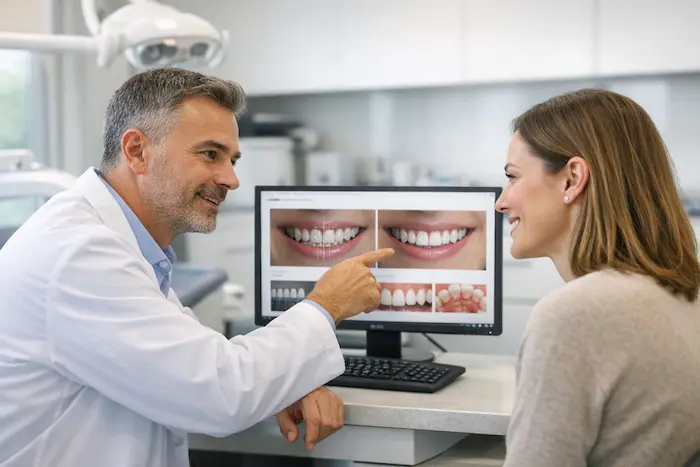
Which Treatments May Be Part of the Process?
Aesthetic improvement may involve one procedure or several procedures combined in a planned sequence. Porcelain or laminate veneers are commonly considered when the goal is to correct shape, mild spacing, surface irregularities, or certain types of discoloration. E-max veneers may be preferred in cases where light transmission and a natural appearance are especially important. Zirconia crowns may be considered when the tooth structure requires more support or when previous damage is more extensive.
Teeth whitening may be recommended for patients whose main concern is color rather than shape. Composite bonding can be useful for small corrections and may offer a more conservative option in selected cases. Gum contouring may improve the frame of the smile when the gum line appears uneven or excessively visible. In some patients, aligner treatment or orthodontic planning may be necessary before cosmetic restorations are considered, especially if crowding or bite problems are present.
This is why smile makeover planning should always begin with diagnosis rather than product selection. The best option is not the most popular treatment, but the one that matches the patient’s dental condition and expectations.
Why the Term Is Popular in Turkey
The phrase is widely used because many international patients search for aesthetic dental care under this name when comparing treatment options abroad. In practice, however, dentists usually approach the subject through the principles of cosmetic dentistry, restorative dentistry, and digital smile design. The popular term may attract attention, but the real clinical process depends on examination findings, radiographic evaluation when needed, photographic analysis, and a discussion of realistic goals.
Turkey has become well known in this area partly because many clinics and hospitals offer multidisciplinary dental care, modern imaging tools, and treatment planning that can combine restorative and aesthetic procedures. Even so, the success of treatment should not be measured by how white or uniform the teeth appear in photographs alone. A successful outcome is one that looks balanced, feels comfortable, supports oral health, and remains functional in daily life.
What Patients Usually Expect From This Treatment
Most patients seeking this type of smile improvement want a cleaner, brighter, and more symmetrical appearance. Common expectations include whiter teeth, more even tooth lengths, closure of small gaps, correction of chips or worn edges, and a smile line that looks more harmonious with the lips and face. Some also hope to achieve a younger appearance, since worn, discolored, or irregular teeth can affect overall facial expression.
At the same time, realistic expectations are essential. Aesthetic dentistry is not only about creating a very white smile. The size, color, translucency, and contour of the teeth should suit the individual’s age, facial features, skin tone, and natural expression. A result that appears too opaque, too large, or too uniform may look artificial rather than healthy. For that reason, careful planning and patient-dentist communication are central to the process.
Aesthetic Goals Should Be Balanced With Oral Health
An attractive smile should never come at the expense of dental health. Before aesthetic procedures are planned, issues such as gum disease, untreated cavities, tooth sensitivity, infection, bite problems, or bruxism should be identified and managed. In some cases, the most responsible approach is to delay cosmetic treatment until oral health is stabilized. This protects both the patient and the long-term success of the final result.
In summary, a Hollywood smile in Turkey refers to a personalized aesthetic dental treatment plan that may combine several techniques to improve the appearance of the teeth and gums. It is not a single method and it should not be approached as a one-size-fits-all solution. When planned carefully, it can support a more harmonious smile while maintaining comfort, function, and oral health.
Who Is a Good Candidate for a Hollywood Smile?
Not every patient who wants a more attractive smile needs the same type of treatment. A good candidate for a Hollywood smile is not defined only by a desire for whiter or more even-looking teeth. The decision depends on the condition of the teeth and gums, the patient’s bite, oral hygiene habits, general expectations, and whether aesthetic goals can be achieved in a safe and conservative way. For this reason, candidacy should always be based on clinical evaluation rather than appearance alone.
In many cases, patients seek smile enhancement because they are unhappy with discoloration, small gaps, chipped edges, worn surfaces, mild irregularities, or an imbalanced gum line. These concerns may be improved with a personalized smile design plan. However, the most suitable patients are those whose oral health can support aesthetic treatment and whose expectations are realistic. A successful result depends not only on what looks good in the mirror, but also on whether the teeth and supporting tissues can maintain that result over time.
Patients With Cosmetic Concerns May Be Suitable Candidates
Many suitable candidates are people who already have generally healthy teeth and gums but want to improve the appearance of their smile. Common concerns include yellowing or staining that does not respond well enough to routine cleaning, uneven tooth shape, minor spacing issues, old restorations that no longer match the natural teeth, or incisal edges that have become worn over time. In such cases, treatment may involve whitening, bonding, veneers, gum contouring, or a combination of these methods.
Some patients are also good candidates because they want to correct the overall balance of the smile rather than address a single problem. For example, the teeth may appear too short, asymmetrical, or visually inconsistent when the person speaks or smiles. In these situations, digital smile design and detailed planning can help determine whether aesthetic treatment is appropriate and which methods are most conservative.
Patients who understand that treatment should be individualized are often better candidates than those looking for a standard cosmetic package. A natural, healthy-looking result usually comes from choosing the least invasive approach that can still meet the patient’s goals.
Healthy Gums and Good Oral Hygiene Matter
One of the most important requirements for aesthetic dental treatment is healthy gum tissue. The gums frame the teeth, and their condition directly affects both appearance and stability. If a patient has active gum disease, inflammation, bleeding, recession, or poor plaque control, cosmetic treatment may need to be delayed until these issues are managed. Placing restorations in a mouth with unstable periodontal health can compromise both aesthetics and long-term success.
Daily oral hygiene also plays a major role in candidacy. Patients who brush effectively, clean between the teeth, attend regular dental controls, and follow professional advice are more likely to maintain their results over time. On the other hand, patients with poor hygiene habits may be at greater risk for staining, gum problems, recurrent decay around restorations, and dissatisfaction after treatment.
For this reason, the evaluation process is not limited to how the teeth look at one appointment. It also considers whether the patient is prepared to care for the final result in the months and years ahead.
Bite Problems, Clenching, and Grinding Must Be Evaluated Carefully
A patient may appear to be a good cosmetic candidate at first glance but still require additional assessment because of functional issues. Bruxism, clenching, tooth grinding, and bite imbalance can place excessive pressure on veneers, crowns, bonding materials, and natural enamel. If these factors are ignored, even a visually attractive result may be more likely to chip, fracture, or wear prematurely.
This does not always mean that smile improvement is impossible. It means the treatment plan must be more careful. Some patients may need a protective night guard, bite adjustment, orthodontic planning, or more durable restorative options depending on the severity of the problem. The goal is to reduce unnecessary risk and create a smile that functions well as well as looks harmonious.
Patients with jaw discomfort, frequent headaches related to clenching, flattened tooth edges, or a history of broken restorations should be assessed thoroughly before any cosmetic treatment is started.
Realistic Expectations Are Essential
A good candidate is also someone with realistic goals. Many patients want a brighter and more symmetrical smile, but the best outcomes usually come when the patient understands that natural beauty does not always mean extremely white, perfectly identical teeth. Tooth shape, translucency, facial proportions, lip line, age, and skin tone all influence what looks appropriate.
Some individuals may bring photographs of celebrity smiles or social media images and expect the same result regardless of their own dental anatomy. In reality, each mouth has different structural limits and different needs. The most suitable patients are those who are open to professional guidance and understand that treatment should be adapted to their own face, bite, and oral condition.
Clear communication before treatment is one of the most important parts of the process. It helps define what can realistically be improved and what may require a different or more gradual plan.
Who May Need Additional Treatment Before Smile Design?
Not every patient should begin with veneers or crowns. In some situations, another treatment should come first. Patients with untreated cavities, gum disease, infections, severe crowding, advanced tooth wear, unstable bite relationships, or missing teeth may need restorative, periodontal, or orthodontic care before aesthetic procedures are considered. This stepwise approach is safer and usually leads to more predictable long-term results.
For example, a patient with crooked teeth may think cosmetic restorations are the only answer, when in fact aligner treatment may improve tooth position first and allow a more conservative final result. A patient with severely stained teeth may benefit from whitening before deciding whether restorative work is necessary. Another patient may only need composite bonding for minor corrections instead of a more extensive ceramic plan.
This is why being a candidate does not simply mean wanting a better smile. It means having the right clinical conditions, or being able to reach those conditions through proper preliminary treatment.
When a More Conservative Option May Be Better
A full smile makeover is not always the best first choice. Some patients can achieve satisfying improvement with less invasive methods. Small chips, slight gaps, mild discoloration, and minor contour problems may sometimes be improved without extensive tooth reduction. In carefully selected cases, conservative treatment protects more natural structure while still enhancing appearance.
This point is especially important for younger patients and for individuals who have relatively healthy teeth. If the desired change can be achieved with whitening, bonding, or limited restorative treatment, that option may be more appropriate than a broader intervention. Good candidacy is not about qualifying for the most extensive treatment. It is about finding the most suitable and responsible one.
In summary, a good candidate for a Hollywood smile is someone whose oral health, gum condition, bite, and expectations allow aesthetic treatment to be planned safely and individually. The ideal patient is not simply the one who wants a more attractive smile, but the one whose needs can be met with a clinically sound and realistic treatment plan.
Which Treatments May Be Included in a Hollywood Smile Plan?
A Hollywood smile plan does not refer to one fixed dental procedure. It is a combination of treatments selected according to the patient’s oral condition, aesthetic concerns, and functional needs. Some patients require only minor improvements, while others need a more comprehensive approach involving restorative, cosmetic, and sometimes orthodontic or periodontal procedures. For this reason, the treatment plan should always be based on examination and diagnosis rather than on trends, standard packages, or visual expectations alone.
The main goal of this type of smile design is to create a brighter, more balanced, and more harmonious appearance while preserving comfort, oral health, and daily function. The exact methods included in the plan may vary from one patient to another. In some cases, the focus is mainly on color and shape. In others, the plan must also address gum symmetry, bite support, worn teeth, or previous restorations that no longer look natural. A well-designed approach considers not only how the smile appears in photographs, but also how it feels during speaking, chewing, and routine oral care.
Porcelain Veneers and Laminate Veneers
Porcelain veneers are among the most commonly discussed options in smile design. These are thin ceramic restorations placed on the front surface of the teeth to improve shape, color, minor spacing issues, and overall symmetry. They are often considered when the patient has discoloration that is difficult to correct with whitening alone, small chips, worn edges, mild irregularities, or teeth that appear too short or uneven.
Laminate veneers are a more conservative form of veneer treatment in selected cases. When the tooth structure is suitable, they may require minimal preparation and can provide a natural appearance because of their thin design and light-transmitting qualities. They are usually considered for patients who want visible aesthetic improvement without extensive intervention, although not every patient is a suitable candidate for this approach.
Veneers are often chosen when the front teeth are structurally sound but cosmetically unsatisfactory. However, they are not the right answer for every problem. If the teeth are heavily damaged, have large restorations, or need more support, another treatment may be more appropriate.
E-max Veneers and Other Ceramic Options
E-max restorations are frequently included in aesthetic treatment planning because they can offer a natural-looking appearance with good translucency. They are often used when the patient’s priority is a refined, lifelike result, especially in the visible front teeth. In cases where the underlying tooth condition and bite are appropriate, they may be selected for patients seeking brightness and symmetry without an opaque or artificial appearance.
The decision to use one ceramic system over another should depend on clinical findings rather than popularity alone. Factors such as tooth color, enamel condition, bite pressure, parafunctional habits, and the amount of correction needed all influence the final material choice. Aesthetic treatment is most successful when material selection follows diagnosis, not marketing language.
Zirconia Crowns When More Support Is Needed
Zirconia crowns may be included in a Hollywood smile plan when the teeth need more structural coverage than veneers can provide. This may be the case if the teeth are severely weakened, previously treated, heavily filled, broken, or significantly worn. In such situations, full coverage restorations may offer better support and durability.
Zirconia is often discussed in aesthetic dentistry because it combines strength with an improved visual appearance compared with older restorative materials. It may be considered when the treatment plan must balance aesthetics with function, especially in patients who have more demanding mechanical needs. Even so, crowns should not be used routinely when a more conservative method would be enough. Preserving healthy tooth structure remains an important principle of responsible treatment planning.
Teeth Whitening for Color Improvement
Not every patient needs veneers or crowns to improve their smile. In some cases, professional teeth whitening may be one of the most effective parts of the treatment plan. Whitening is often considered when the main concern is discoloration rather than shape, spacing, or structural damage. It can help brighten natural teeth and may also serve as a first step before deciding whether additional cosmetic treatment is necessary.
Whitening may be useful for patients who have staining related to age, food and beverage habits, smoking, or natural variation in tooth shade. It may also improve the overall result when combined with bonding or limited restorative treatment. However, whitening does not change the shape of the teeth, close gaps, or correct alignment problems. It also does not alter the color of crowns, veneers, or existing tooth-colored restorations. For this reason, its role in a smile plan must be evaluated carefully and realistically.
Composite Bonding for Minor Corrections
Composite bonding is another treatment that may be included in a smile design plan, especially when the changes needed are relatively small. This technique uses tooth-colored resin to repair chips, improve contour, close small spaces, or make slight shape adjustments. In selected patients, bonding can offer a more conservative option because it usually removes little or no natural tooth structure.
Bonding may be suitable for mild imperfections, but it is not always the best choice for long-term correction of more complex aesthetic concerns. The final decision depends on the size of the correction, the patient’s bite, oral habits, and expectations regarding durability and maintenance. In the right case, however, bonding can be an effective part of a balanced and minimally invasive smile improvement plan.
Gum Contouring and Periodontal Aesthetic Procedures
The appearance of the smile is influenced not only by the teeth but also by the gums. Some patients have teeth that appear short because of uneven or excessive gum display. Others may have an asymmetrical gum line that affects the overall balance of the smile. In such situations, gum contouring or other periodontal aesthetic procedures may be considered as part of the treatment plan.
These procedures are intended to improve the frame around the teeth and help create more proportionate tooth exposure. In many cases, even a small correction in the gum line can significantly improve smile harmony. However, gum procedures should always be planned carefully, with attention to periodontal health and biological safety rather than appearance alone.
Orthodontic Treatment or Aligners Before Cosmetic Work
Some patients believe they need veneers or crowns when the real underlying issue is tooth position. Mild to moderate crowding, spacing, or bite irregularities may sometimes be addressed more conservatively with aligners or orthodontic treatment before aesthetic restorations are considered. This can improve tooth alignment and allow later cosmetic treatment to be more limited, more natural, and less invasive.
Orthodontic preparation may not be necessary for every patient, but it is an important part of proper planning when position rather than color or surface shape is the main concern. In these cases, rushing directly into restorative treatment may lead to unnecessary reduction of healthy tooth structure.
Additional Restorative or Supportive Procedures
A smile plan may also include replacement of old fillings, renewal of discolored restorations, treatment of cavities, management of tooth wear, or stabilization of the bite before aesthetic work begins. In some patients, protective measures such as a night guard may be recommended after treatment, especially if clenching or grinding is present. These supportive steps may not be the most visible part of the process, but they are often essential for protecting the final outcome.
In summary, a Hollywood smile plan may include veneers, laminate veneers, E-max restorations, zirconia crowns, teeth whitening, composite bonding, gum contouring, orthodontic treatment, and other restorative procedures depending on the patient’s needs. The most appropriate combination is not determined by trend or routine, but by careful examination, conservative planning, and the goal of achieving an aesthetic result that also respects oral health and function.
How the Hollywood Smile Process Works in Turkey
The process usually begins with a detailed consultation rather than immediate treatment. Although many patients use the term Hollywood smile as if it describes one standard procedure, the actual workflow is based on individual diagnosis, planning, and step-by-step decision-making. In Turkey, as in other settings where aesthetic dentistry is performed responsibly, the process should not start with choosing the brightest shade or the fastest cosmetic option. It should begin with understanding the patient’s oral health, smile concerns, and expectations, then building a treatment plan that is suitable for both appearance and function.
A well-planned process typically includes clinical examination, photographic assessment, evaluation of gum health, review of bite relationships, and discussion of previous dental work. Some patients may move forward with a relatively simple plan, while others may need preparatory care before any cosmetic step is taken. This is one of the most important points to explain clearly: treatment is not only about creating an attractive appearance within a short period of time. It is about creating a smile that is balanced, maintainable, and appropriate for the patient’s dental condition.
Initial Consultation and Smile Assessment
The first stage is a comprehensive assessment. During this phase, the dentist listens to the patient’s concerns and evaluates what is causing dissatisfaction with the current smile. Some patients are mainly concerned about discoloration, while others are more affected by asymmetry, tooth wear, gaps, short teeth, uneven gum display, or previous restorations that look unnatural. A proper consultation identifies these concerns individually rather than assuming that every patient wants the same type of result.
At this stage, the teeth, gums, bite, and overall smile line are examined carefully. The dentist may assess how much of the teeth show at rest, how the smile appears during speech, whether the gum line is even, whether the front teeth are proportionate, and whether there are signs of grinding or clenching. Existing fillings, crowns, veneers, or other dental work are also reviewed, since they may influence both treatment options and final color matching.
This phase is also important because it helps establish realistic goals. Patients often arrive with visual examples or general expectations, but the final plan should be based on their own facial features, oral condition, and functional needs rather than on copied images.
Treatment Planning and Digital Smile Design
Once the initial evaluation is complete, the next step is treatment planning. This is where the smile design process becomes more specific. The dentist determines which procedures may be necessary and in what order they should be performed. In some patients, a simple whitening and bonding plan may be enough. In others, the process may involve ceramic restorations, gum contouring, replacement of old dental work, or orthodontic alignment before restorative treatment.
Digital smile design may be part of this stage. It allows the patient and dentist to evaluate tooth proportions, smile symmetry, and possible aesthetic directions before final treatment begins. This can improve communication and help reduce misunderstandings about shape, length, and overall style. It also supports a more measured approach, because it encourages discussion before irreversible procedures are performed.
Planning is one of the most important parts of the entire process. A visually attractive outcome depends not only on the skill of the final restoration, but on whether the underlying decisions were made carefully from the beginning.
Preliminary Treatments When Needed
Not every patient can proceed directly to cosmetic treatment. If gum inflammation, untreated decay, infection, unstable restorations, significant tooth wear, or bite problems are present, these issues usually need to be addressed first. This preliminary stage may include periodontal treatment, cavity treatment, professional cleaning, replacement of old fillings, root canal treatment in selected cases, or management of clenching and grinding.
Some patients may also benefit from orthodontic correction before restorative treatment. If the main issue is crowding or tooth position, moving the teeth first may reduce the need for more invasive cosmetic work later. Similarly, patients who mainly want a brighter smile may begin with whitening before deciding whether additional correction is still needed.
This part of the process may feel less exciting than the cosmetic stage, but it is often essential for long-term success. Skipping necessary preliminary care can compromise aesthetics, comfort, and durability.
Tooth Preparation, Impressions, and Temporary Restorations
If the treatment plan includes veneers or crowns, the next stage may involve tooth preparation. The amount of preparation depends on the type of restoration, the condition of the teeth, and the degree of change required. In conservative cases, minimal preparation may be possible. In more extensive cases, greater adjustment may be needed to create appropriate space, shape, and support for the final restorations.
After preparation, impressions or digital scans are taken so that the restorations can be designed accurately. Shade selection is also part of this step. Choosing a color should be done carefully, because an overly opaque or excessively bright result may look unnatural even if the teeth appear very white. The most suitable shade is one that works harmoniously with the patient’s face, age, and overall smile design.
Temporary restorations may be used in some cases while the final work is being prepared. These temporaries can protect the teeth, support comfort, and give the patient a preliminary idea of tooth length and general appearance.
Try-In, Final Placement, and Adjustment
When the final restorations are ready, a try-in stage may be performed. This allows the dentist to evaluate shape, fit, bite, surface appearance, and visual harmony before definitive placement. Small refinements may sometimes be needed at this stage, especially in the front teeth where symmetry and smile line details are more noticeable.
Once the restorations are approved, they are placed according to the treatment plan. The dentist then checks the bite carefully to make sure the patient can close, speak, and function comfortably. This stage is important because even a beautiful visual result can become problematic if the bite feels unstable or the teeth contact in the wrong way.
After placement, the patient is usually informed about what to expect in the first days, including mild sensitivity in some cases, adaptation to the new contours, and the importance of oral hygiene and follow-up controls.
Follow-Up and Long-Term Monitoring
The process does not end when the treatment is completed. Follow-up appointments are an important part of smile rehabilitation. These visits help confirm that the gums are responding well, the bite remains stable, the patient is adapting comfortably, and no early complications are developing. If the patient has a history of clenching or grinding, a protective night guard may be recommended to protect both the restorations and the natural teeth.
Long-term success depends on maintenance as much as on treatment itself. Daily cleaning, routine professional care, and attention to oral habits all influence how well the final result lasts over time. A Hollywood smile should therefore be understood not as a one-day transformation, but as a planned clinical process followed by ongoing care.
In summary, the Hollywood smile process in Turkey usually involves consultation, examination, personalized treatment planning, preliminary care when needed, restorative or cosmetic procedures, and structured follow-up. The exact journey is different for each patient, but the safest and most reliable results come from a methodical approach that prioritizes oral health, realistic expectations, and careful sequencing of treatment.
Recovery, Aftercare, Longevity, and Possible Risks
Recovery after a Hollywood smile treatment depends on which procedures are included in the plan. For some patients, the process is relatively simple and recovery is minimal, especially when the treatment involves whitening, minor bonding, or limited contour adjustments. For others, recovery may be more noticeable if the plan includes multiple veneers, crowns, gum contouring, or more extensive restorative work. This is why recovery should never be described in one general sentence for every patient. The experience varies according to the number of teeth treated, the condition of the gums, the amount of tooth preparation, and the patient’s individual sensitivity.
In most cases, patients want to know not only how long the visible healing period will last, but also how they should care for their new smile and how long the result is expected to remain stable. These questions are important because aesthetic dentistry is not only about appearance at the moment of placement. Long-term success depends on healing, daily habits, oral hygiene, and the ability of the patient to maintain the result responsibly.
What Recovery May Feel Like in the Early Period
The first days after treatment may involve mild sensitivity, especially if the teeth have been prepared for veneers or crowns, or if whitening has been performed. Some patients notice temporary sensitivity to cold, pressure, or very hot drinks. If gum contouring or other periodontal procedures are part of the plan, the gums may also feel tender or slightly swollen for a short time. These early effects are often manageable, but they should still be explained clearly so that the patient understands what is expected and what is not.
Patients may also need a short period of adaptation to the new shape and surface of the teeth. Even when the final result looks natural, the mouth may initially perceive the restorations as unfamiliar. Speech, lip contact, and bite awareness may feel slightly different at first, especially when multiple front teeth have been treated. This adjustment period is usually temporary, but careful finishing and bite control are important to reduce unnecessary discomfort.
The early recovery phase is also the time when the patient should avoid unnecessary stress on the new work. Hard biting, nail biting, opening packages with the teeth, or consuming very hard foods too soon may place preventable pressure on the restorations and should be avoided.
Aftercare and Daily Oral Hygiene
Aftercare is one of the most important parts of protecting the final result. Even the most aesthetically successful treatment can lose its appearance or stability if oral hygiene is neglected. Patients should continue brushing regularly with an appropriate technique, cleaning between the teeth every day, and attending routine dental controls. Good maintenance helps reduce plaque accumulation, gum inflammation, staining, and the risk of recurrent problems around restorations.
It is also important to remember that aesthetic materials still exist in the oral environment and are affected by daily habits. Smoking, poor hygiene, excessive intake of staining foods and beverages, or irregular professional follow-up may reduce the brightness and freshness of the overall smile. While ceramic materials are more stain-resistant than natural enamel in some situations, they are not completely independent from the surrounding oral conditions. The gums, margins, and natural teeth around the restorations still require consistent care.
Patients who have bonding rather than ceramic restorations may need to be even more attentive to long-term maintenance, since bonding materials can be more vulnerable to staining, surface wear, or small edge defects over time.
Protecting the Results in Daily Life
Aesthetic dentistry should also be protected from mechanical stress. Patients who clench or grind their teeth may be advised to use a night guard, especially after veneers, crowns, or more extensive smile rehabilitation. This recommendation is not a minor detail. Parafunctional habits can place repeated pressure on both restorations and natural teeth, increasing the risk of chipping, fracture, wear, or discomfort.
Daily habits matter as much as night-time habits. Chewing ice, biting hard objects, tearing packaging with the teeth, and other avoidable behaviors may shorten the life of restorations. In a well-planned case, the materials are selected according to the patient’s needs, but even strong restorative materials should not be treated as indestructible.
Patients should also understand that maintaining a natural-looking smile does not depend only on the restorations themselves. Professional cleaning, periodic examination of the bite, and early management of small issues can prevent larger problems later.
How Long the Results May Last
Longevity varies depending on the materials used, the patient’s oral habits, the quality of the treatment plan, and the level of long-term care. Some treatments may remain stable for many years when they are well indicated and properly maintained. However, no dental restoration should be described as permanent in an absolute sense. Over time, restorations may require polishing, repair, replacement, margin evaluation, or bite adjustment.
The patient’s own teeth and gums also continue to change with age. This means that long-term success is not only about whether a veneer or crown stays in place. It is also about whether the surrounding tissues remain healthy, the bite remains balanced, and the overall appearance continues to look harmonious. A realistic explanation of longevity helps patients understand that aesthetic treatment is a long-term commitment rather than a one-time cosmetic event.
Possible Risks and Limitations
Like any dental treatment, a Hollywood smile plan may involve limitations and possible risks. These vary according to the procedures performed. Tooth sensitivity may occur after preparation or whitening. Gum irritation may develop temporarily after periodontal or restorative procedures. Bonding may stain or wear over time. Veneers or crowns may chip, loosen, fracture, or require replacement in some cases, particularly if functional risk factors are not properly controlled.
Another important point is that some cosmetic procedures may involve irreversible steps. If tooth preparation is required, the natural tooth structure cannot simply be restored to its original untreated form. For this reason, treatment decisions should never be rushed, especially in younger patients or in cases where a more conservative option may be enough.
There is also the risk of dissatisfaction when expectations are unrealistic. A smile that is too white, too flat, too uniform, or out of proportion with the patient’s face may appear artificial even if the technical work is well made. This is why communication, planning, and case selection are just as important as technical execution.
Why Long-Term Follow-Up Matters
Follow-up care is essential because it allows the dentist to monitor the health of the gums, the adaptation of the patient, the stability of the bite, and the condition of the restorations over time. Small problems may be corrected early before they become more significant. This is particularly important in patients with grinding habits, previous restorative history, or more complex smile design cases.
Regular review also helps preserve the natural appearance of the result. A smile may look excellent at the time of placement, but its long-term success depends on how well it is maintained and whether the supporting tissues remain healthy. A responsible treatment process therefore includes not only delivery of the final smile, but also a plan for monitoring it.
In summary, recovery after a Hollywood smile depends on the procedures included in the treatment plan, while long-term success depends heavily on aftercare, oral hygiene, protective habits, and realistic expectations. The final result may remain stable for many years in well-selected cases, but patients should still understand that aesthetic dental work requires ongoing care and may involve certain risks, limitations, and future maintenance needs.
Hollywood Smile Cost in Turkey: What Affects the Treatment Plan?
The cost of a Hollywood smile in Turkey is not determined by one fixed fee, because this type of treatment is not a single procedure. It is a personalized plan that may involve different methods depending on the patient’s dental condition, aesthetic goals, and functional needs. For this reason, the total cost can vary significantly from one patient to another. A person who needs only whitening and minor bonding will not have the same treatment scope as a patient who requires multiple ceramic restorations, gum contouring, replacement of old crowns, or preliminary dental care before cosmetic work begins.
This is an important point for patients to understand from the beginning. When treatment is described as though it has a universal price, it may create unrealistic expectations and overlook the clinical differences between cases. A more responsible explanation is that cost depends on diagnosis, treatment content, material selection, technical complexity, and the long-term goals of the case. In aesthetic dentistry, a meaningful cost discussion should always follow examination and planning rather than come before them.
The Number of Teeth Involved
One of the most direct factors affecting the treatment plan is the number of teeth included. Some patients want improvement in only the upper front teeth, while others require treatment in both the upper and lower visible smile zone. In certain cases, only a few teeth need correction because the rest of the smile is already balanced. In other cases, more teeth must be included to achieve harmony in color, width, length, and smile line.
As the number of treated teeth increases, the complexity of planning, restorative work, and clinical chair time also increases. This naturally affects the total scope of treatment. However, the decision should not be based only on the patient’s wish for a larger or smaller number of restorations. The real question is how many teeth need to be included for the smile to look balanced and clinically appropriate.
The Type of Treatment Used
Another major factor is the type of treatment selected. Teeth whitening, composite bonding, porcelain veneers, laminate veneers, E-max restorations, zirconia crowns, gum contouring, and orthodontic preparation do not represent the same level of intervention. Each method involves different materials, laboratory stages, clinical techniques, and maintenance expectations.
For example, a patient whose main concern is tooth color may need a simpler treatment plan than someone whose teeth are worn, restored, asymmetrical, or structurally compromised. A conservative option may be sufficient in one case, while another may require broader restorative support. This is why treatment planning should focus on what is necessary rather than on what is most commonly advertised. The correct approach is not to start from a cosmetic label and force every case into that model, but to identify which procedures are actually required.
Material Choice and Technical Complexity
Material selection can also influence the overall treatment plan. Ceramic systems, bonding materials, and restorative approaches differ in their clinical indications, esthetic qualities, strength, and technique sensitivity. The decision between laminate veneers, E-max restorations, zirconia crowns, or another type of restoration should depend on enamel condition, bite forces, discoloration level, existing restorations, and the type of result the clinician is trying to achieve.
Technical complexity matters as much as the material itself. A straightforward case involving minor aesthetic correction is very different from a case that requires major shade change, replacement of mismatched restorations, bite correction, gum line improvement, and coordination between several treatment steps. When the case becomes more complex, both the clinical and laboratory components become more detailed as well.
Preliminary Dental Treatment Before Aesthetic Work
Some patients are surprised to learn that the visible cosmetic stage is not always the first step. Before aesthetic treatment begins, certain oral health issues may need to be treated. These may include professional cleaning, cavity treatment, gum therapy, replacement of defective fillings, management of infection, or correction of bite-related problems. In some cases, aligners or orthodontic treatment may be recommended before restorative work so that the final result can be achieved more conservatively.
These preliminary steps are not separate from the smile plan. They are part of what makes the final treatment safer and more predictable. A lower apparent starting cost may seem attractive at first, but if necessary health-related steps are ignored, the final outcome may be less stable or require correction later. For this reason, cost should be understood in relation to the full clinical pathway, not just the visible cosmetic phase.
Laboratory Work and Individualized Design
Aesthetic dental treatment often requires close coordination between the clinical team and the dental laboratory. The more individualized the case, the more detailed this process becomes. Shade matching, tooth anatomy, translucency, surface texture, edge design, and smile symmetry all contribute to the final appearance. A result that looks natural and balanced usually depends on careful planning and detailed workmanship rather than on speed alone.
This laboratory component is particularly important in cases involving multiple anterior restorations, where even small differences in contour or light reflection may affect the overall smile. As a result, the treatment plan is shaped not only by how many restorations are needed, but also by how precisely they must be designed and integrated with the patient’s facial features and natural dental appearance.
Why a Standard Package May Be Misleading
The idea of a standard Hollywood smile package can be misleading because it suggests that every patient needs the same number of restorations, the same materials, and the same sequence of treatment. In reality, this is rarely the case. A patient with healthy teeth and mild cosmetic concerns may need a relatively conservative plan, while another patient with extensive wear, previous crowns, gum imbalance, and functional issues may require a more comprehensive approach.
When treatment is presented in a package format without adequate examination, important differences between cases may be overlooked. From a patient care perspective, a more reliable model is personalized treatment planning based on diagnosis. This supports both safety and transparency, especially for patients comparing options and trying to understand why treatment proposals may differ.
Long-Term Value Should Also Be Considered
Cost should not be viewed only as the starting point of treatment. Patients should also think about long-term value, including maintenance, durability, possible repairs, the need for follow-up, and how well the chosen treatment fits their actual dental condition. A treatment plan that is more conservative and biologically respectful may be more appropriate in the long term than a broader intervention that removes more tooth structure than necessary.
Aesthetic dentistry should therefore be evaluated not only in financial terms, but also in relation to oral health, comfort, expected longevity, and future maintenance needs. A realistic and well-explained cost discussion helps patients understand that the goal is not simply to obtain a cosmetic result, but to achieve a stable and well-planned improvement.
In summary, the cost of a Hollywood smile in Turkey depends on the number of teeth involved, the procedures included, the materials selected, the need for preliminary treatment, the technical complexity of the case, and the level of individualized planning required. Because the treatment is highly personalized, cost can only be understood properly after a full evaluation has identified what the patient truly needs.
Is a Hollywood Smile Always the Right Choice?
A Hollywood smile is not always the right choice for every patient, and this is one of the most important points in aesthetic dentistry. Although the term is widely used to describe a bright, balanced, and attractive smile, the most appropriate treatment is not determined by trend, popularity, or visual preference alone. The right decision depends on the condition of the teeth and gums, the patient’s bite, age, expectations, oral habits, and whether the desired result can be achieved in a safe and conservative way. For some people, a comprehensive smile design plan may be appropriate. For others, a simpler, less invasive, or more gradual approach may be the better option.
This distinction matters because cosmetic dental treatment should not be planned as if every patient needs the same level of intervention. A person may arrive expecting veneers or crowns on many teeth, while the real need may be whitening, limited bonding, orthodontic correction, gum treatment, or simply replacement of old restorations. In responsible treatment planning, the question is not whether a patient wants a Hollywood smile. The more important question is whether that approach is truly necessary and suitable for that individual case.
Aesthetic Treatment Should Be Guided by Need, Not by Trend
One of the reasons this topic requires careful discussion is that many patients encounter highly standardized visual examples online. These examples may create the impression that a very white, uniform smile is the ideal outcome for everyone. In reality, aesthetic treatment is most successful when it respects the patient’s own facial proportions, oral condition, and natural dental characteristics. A result that appears attractive in a photograph may not be the most appropriate solution for every mouth.
In some cases, a patient may request extensive ceramic treatment even though the teeth are healthy and only minor cosmetic concerns are present. If the desired improvement can be achieved with whitening, bonding, limited contour adjustment, or orthodontic movement, these options may preserve more natural tooth structure. A broader restorative plan is not automatically better simply because it produces a dramatic visual change. In many situations, the most appropriate treatment is the one that achieves improvement with the least unnecessary intervention.
When a More Conservative Option May Be Better
A Hollywood smile may not be the first or best choice when the patient’s concerns are mild. Slight discoloration, small chips, minor asymmetry, or narrow gaps may sometimes be corrected with conservative methods. Professional whitening may improve color without changing tooth structure. Composite bonding may restore contour or close small spaces. Orthodontic treatment or clear aligners may improve tooth position more naturally than placing restorations over misaligned teeth. Gum contouring may also improve smile balance without the need for multiple veneers or crowns.
These options are especially important when the natural teeth are otherwise healthy. Preserving enamel is an important principle in modern dentistry, and it should not be overlooked in the pursuit of cosmetic change. If the patient can achieve a satisfying result with a more limited approach, that possibility should be discussed carefully before more invasive treatment is planned.
Functional Problems May Need Priority Over Cosmetic Goals
There are also situations in which a Hollywood smile is not the right immediate choice because oral health or function must be addressed first. Active gum disease, untreated cavities, tooth infection, unstable restorations, severe wear, or significant bite imbalance should not be ignored in favor of purely cosmetic treatment. In these cases, the patient may still become a suitable candidate later, but only after the underlying problems have been treated.
The same principle applies to patients with clenching or grinding habits. Bruxism can place excessive pressure on teeth and restorations, increasing the risk of fracture, chipping, sensitivity, or treatment failure. This does not always prevent aesthetic treatment, but it may change the treatment plan significantly. A patient with strong functional risk factors may need a different restorative strategy, additional protective measures, or a more cautious level of intervention.
A smile can only be considered successful when it functions well as well as looks balanced. For that reason, it is not appropriate to separate aesthetics from oral health and bite stability.
Younger Patients Require Careful Judgment
Age is another important factor in decision-making. Younger patients often seek cosmetic improvement because they are influenced by social media images, digital filters, or idealized smile trends. However, a young patient with healthy enamel and relatively minor imperfections may not benefit from aggressive treatment that removes more tooth structure than necessary. In such cases, conservative options deserve particular attention.
Aesthetic dentistry in younger individuals should be planned with long-term responsibility in mind. Dental restorations may require maintenance, repair, or replacement over time. Therefore, beginning with the most extensive option too early may create a longer future treatment cycle than necessary. A careful, staged, and minimally invasive approach is often more appropriate when the patient is young and the teeth are otherwise healthy.
Unrealistic Expectations Can Make Any Treatment Inappropriate
Even when the teeth and gums are suitable, a Hollywood smile may still be the wrong choice if the patient’s expectations are unrealistic. Some patients request extremely white, perfectly identical teeth without considering how this may look in relation to their face, age, lip line, or natural expression. Others may expect cosmetic dentistry to correct problems that actually require orthodontic, periodontal, or restorative management first.
Aesthetic treatment is not only about creating a dramatic difference. It is about creating a result that appears harmonious, healthy, and sustainable. If the patient expects an outcome that is visually exaggerated or biologically inappropriate, treatment planning becomes more difficult and the risk of dissatisfaction increases. Honest discussion before treatment is therefore essential. A good result depends not only on technical quality, but also on whether the treatment goals are realistic from the beginning.
A Hollywood Smile May Be Appropriate in the Right Case
Although it is not always the right choice, a Hollywood smile can be a suitable option in carefully selected patients. It may be appropriate when the person has multiple aesthetic concerns affecting the visible smile zone, when oral health is stable or can be stabilized, when the patient understands the available options, and when the treatment plan has been designed individually. In these cases, smile design can improve color, shape, proportion, and overall harmony while respecting function and long-term maintenance.
The key point is that suitability must be determined clinically, not emotionally or commercially. A responsible plan is based on diagnosis, conservative judgment, and clear communication. This protects the patient from unnecessary intervention and helps create results that are more natural and durable.
In summary, a Hollywood smile is not always the right choice for every patient. In some situations, a more conservative alternative may be safer and more appropriate. In others, preliminary dental treatment may be necessary before cosmetic work is considered. The most suitable approach is the one that matches the patient’s actual needs, preserves oral health, and achieves aesthetic improvement without unnecessary treatment.
FAQ
What is included in a Hollywood smile treatment?
A Hollywood smile treatment is not a single procedure. It is a personalized smile design plan that may include porcelain veneers, laminate veneers, E-max restorations, zirconia crowns, teeth whitening, composite bonding, gum contouring, or orthodontic treatment. The exact combination depends on the patient’s oral condition, cosmetic concerns, and functional needs. Some patients need only minor correction, while others require a more comprehensive restorative and aesthetic plan.
Is a Hollywood smile the same as veneers?
No, a Hollywood smile is not the same as veneers. Veneers may be one part of the treatment, but the overall concept refers to a broader smile design approach. In some cases, the plan may include whitening, bonding, orthodontic correction, or gum reshaping instead of or in addition to veneers. The term describes the final aesthetic goal rather than one fixed method.
How long does a Hollywood smile treatment take in Turkey?
The treatment time depends on the number of procedures included. A relatively simple plan may take a shorter period, while a more complex case involving gum treatment, multiple restorations, or preliminary dental care may require more time. The overall timeline should always be determined after examination and treatment planning, because each case has different clinical needs.
Is the procedure painful?
Most patients tolerate the process well, but the level of discomfort depends on the type of treatment performed. Whitening, bonding, and minor contour adjustments are usually associated with limited discomfort. If veneers, crowns, or gum contouring are involved, temporary sensitivity or tenderness may occur. The patient’s individual pain threshold, oral condition, and the extent of treatment all affect the experience.
How long do Hollywood smile results last?
Longevity varies depending on the materials used, the patient’s oral hygiene, bite habits, and long-term maintenance. Well-planned and properly maintained treatment may remain stable for many years, but no restoration should be considered permanent without future care. Some cases may require polishing, repair, replacement, or protective measures over time.
Can teeth whitening alone create a Hollywood smile?
In some patients, whitening alone may significantly improve the appearance of the smile, especially when the main issue is tooth color. However, whitening does not change tooth shape, correct spacing, repair worn edges, or improve alignment. If the patient’s concerns involve more than color, additional procedures may be needed as part of the smile design plan.
Are zirconia crowns and E-max veneers the same thing?
No, they are different restorative options. E-max restorations are often chosen when a highly natural appearance and light transmission are important, especially in the front teeth. Zirconia crowns may be considered when greater structural support is needed. The decision should be based on the patient’s tooth condition, bite forces, and aesthetic goals rather than on general preference alone.
Can patients with crooked teeth have a Hollywood smile?
Some patients with mild alignment issues may still be suitable candidates for aesthetic treatment, but others may benefit from orthodontic correction or aligners before restorative procedures are considered. If the main problem is tooth position, moving the teeth first may allow a more conservative and natural result. This is why proper diagnosis is essential before treatment selection.
Is a Hollywood smile suitable for everyone?
No, it is not suitable for every patient. Some individuals may need gum treatment, cavity treatment, bite stabilization, or orthodontic care before cosmetic procedures are planned. Others may be better suited to a more conservative option such as whitening or bonding. The right approach depends on oral health, expectations, age, habits, and the amount of correction actually needed.
What should patients avoid after treatment?
Patients should avoid habits that may stress the teeth or restorations, such as biting very hard objects, opening packaging with the teeth, or ignoring grinding and clenching habits. Good oral hygiene, routine controls, and careful daily maintenance are important for protecting the long-term appearance and stability of the final result.
Is This Treatment Performed at Our Hospital?
Hollywood smile planning and related aesthetic dental procedures are also performed at our hospital. However, the treatment approach is not based on a fixed cosmetic template. Each patient is evaluated individually, and the treatment plan is shaped according to oral health, smile aesthetics, functional needs, and long-term suitability. When necessary, preliminary care may be completed before aesthetic procedures are considered. This helps support a more balanced, safe, and clinically appropriate result.